My Ministry
Ministry shows up in many ways and places - from the pulpit to the boardroom, from hospital bedsides to strategic planning sessions. Here's my approach to:


Click an image to open video in a new window
Worship
Leading services, leading worship, is one of my favorite things! To be able to shepherd a congregation through a shared experience of finding/making truth and meaning is both an art and a privilege.
Prior to completing my ministerial preparation, I was an itinerant preacher throughout the Prairie Star District. Between that, the congregations I have served, and my experience on Congregational Life Staff, I have had the privilege of preaching in over 50 of our UU congregations – from large to small; from congregations that meet in school cafeterias to buildings that are hundreds of years old; from congregations of under a dozen to several thousand at General Assembly. I've led worship in-person, strictly online, and hybrid services that bring together the online and in-person congregations.
Pastoral Care
Pastoral care happens in two ways: care of individuals and care of the congregation itself.
Care of Individuals: My Clinical Pastoral Education (CPE) experience - in a level 1 trauma center, with heart patients, and on the maternity ward - taught me to listen deeply to the person before me. In congregations, this shows up both formally (appointments, hospital visits) and informally (after-service check-ins, meeting moments). Pastoral care happens in small doses when we're truly present and paying attention.
Care of the Congregation: Congregations themselves also often need pastoral care. This might mean naming losses the congregation has experienced, using Appreciative Inquiry to remember what's wonderful about the community, or helping shift from scarcity to gratitude. In congregations with histories of ministerial misconduct, it may look like rebuilding trust in ministry itself. Pastoral care of the congregation as a system is essential ministry.


Religious Education
Faith development is lifelong, grounded in the stories we tell about our values, our meaning, ourselves, and each other. These stories can be sacred to us as individuals and as a faith community.
Each congregation is organized differently as to how religious education is formally provided – which committees or staff people are responsible for which age groups.
I enjoy providing adult religious education classes and workshops, as well as working with the religious education professionals and lay people to ensure that we are intentional about how religious education happens formally (through RE Classes and Sunday Services that are thematically connected) and the way that it happens informally (such as how we treat one another during coffee hour or what rituals are sacred to the congregation).
Leadership &
Organizational Development
Healthy congregations need governance that fits who they actually are - not who they were 20 years ago, or who they hope to become someday. Right-sizing governance to match your current capacity and development stage is foundational work. When structures align with reality, more energy flows toward mission instead of draining away in unsustainable systems.
This kind of work - helping congregations build capacity for embodying their mission - is exactly what I did as Congregational Life Staff for the UUA's Southern Region. In our Leadership Experiences, we taught systems theory, change management, equity lenses, governance models, board development, leadership as calling, and how culture shapes strategy. I loved that work, and I bring it to every congregation I serve.
Our congregations often talk about the difference between technical problems and adaptive challenges. If technical problems get solved through administration, adaptive challenges require organizational development - which means congregations need to learn new ways of doing and being. This is transformative work!


It’s hard to get a good picture of me doing administration. Basically, it would look like me intently focusing on a spreadsheet or a bunch of printed financial reports. That is why I chose to use the picture of me being goofy and fun with my cohort at the School of Public & Environmental Affairs at Indiana University, where I graduated with honors in 2019.
Administration
If the congregation's mission is the foundation, administration provides the scaffolding from which the vision can be realized. And yet congregations often struggle with administration - it's not energizing for most people. But I love this work!
I thrive in bringing systematic thinking to financial management: running financial ratios, developing sound policies, diversifying funding streams, and building healthy stewardship cultures. I'm skilled in strategic human resource management, effective volunteer engagement, crisis communication, and the concrete operational systems that keep organizations functioning well.
I earned my Masters in Public Administration (with a focus in Nonprofit Management) because I wanted to learn how the nonprofit world was adapting to changing volunteer and fundraising landscapes. As it turns out, the learning goes both ways: congregations can learn from nonprofits, and nonprofits can learn from congregations.
This is concrete work in a profession that's often relational and abstract - and I enjoy both.
Social Justice
I've marched, organized, and showed up for justice work. I know what it means to be present in the streets and in community partnerships. But as a minister, my social justice focus has shifted to helping congregations develop their own sustainable justice programs rather than being their representative in the community. Here's why:
When congregations rely on their minister to lead their social justice work and be their face in community partnerships, they lose those community relationships every time the minister changes. The work becomes dependent on one person rather than rooted in the congregation's own commitments and connections.
Instead, now I work with congregations to build justice programs that are truly theirs. This might mean restructuring what exists, building capacity where there's energy, or helping a congregation move from being "an inch deep and a mile wide" to focusing on fewer issues with real depth and impact. It might mean developing authentic partnerships with community organizations and impacted people, or discerning which justice work actually aligns with your congregation's gifts and calling.
I've done the work and I know what it takes. This is exactly why I now focus on equipping congregations to sustain their own justice witness beyond any particular ministry.
One of the tools I have created to do this work is the Social Justice Grid.
 Clergy at the Breonna Taylor Protests in Louisville |
|---|
 Road Rally for Reproductive Justice in Frankfort, KY |
 Injustice Square, Louisville, KY |
 Planned Parenthood Rally in Louisville |
 Sanctuary Movement in Lousiville |
 Marriage Equality Hits Indiana |
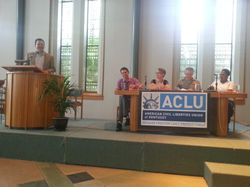 ACLU Panel |
 Rally at Metro Square, Louisville |
 Changing Banners at First U Louisville |
 Protesting Unjust Immigration Laws |
 Environmental Justice at General Assembly |
 Speaking before Metro Council, Louisville |
 I Love Mountains Day at Frankfort, KY |